
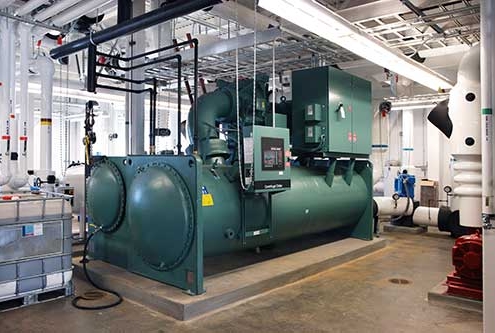
A water-cooled screw chiller is a type of mechanical refrigeration system designed to remove heat from a space or process fluid using water as the heat transfer medium. It’s widely used in large-scale cooling applications where precise temperature control and high efficiency are required. Unlike air-cooled chillers that use air to dissipate heat, water-cooled screw chillers use water to carry away the heat generated during the cooling process. This makes them particularly well-suited for applications where air-cooled systems may be less efficient or impractical.
Key Components of a Water-Cooled Screw Chiller
A water-cooled screw chiller comprises several key components, each playing a critical role in its operation. Let’s break down these components and their functions:
Compressor: The heart of the chiller, the compressor, is responsible for compressing the refrigerant gas. In a water-cooled screw chiller, a twin-screw compressor is commonly used. It functions by squeezing the refrigerant gas, increasing its temperature and pressure.
Condenser: The high-pressure, high-temperature refrigerant gas leaves the compressor and enters the condenser. In a water-cooled chiller, this component typically consists of a shell-and-tube heat exchanger. Here, the refrigerant releases its heat to the water, causing it to condense into a high-pressure liquid.
Evaporator: After exiting the condenser, the high-pressure liquid refrigerant enters the evaporator, another heat exchanger. In this component, it absorbs heat from the chilled water or process fluid, causing it to evaporate and return to a low-pressure gas state.
Expansion Valve: The expansion valve controls the flow of refrigerant into the evaporator. It reduces the pressure and temperature of the refrigerant, preparing it for the evaporation process.
Chilled Water Loop: This is the system responsible for circulating the chilled water or process fluid to the areas or equipment that require cooling. It typically consists of pumps, pipes, and heat exchangers.
Condenser Water Loop: This loop facilitates the exchange of heat between the refrigerant and the cooling water. It includes pumps, pipes, and cooling towers or water-cooled condensers.

Operational Principles of a Water-Cooled Screw Chiller
Now that we understand the key components, let’s explore how these components work together in the operation of a water-cooled screw chiller:
Compression: The process begins when the twin-screw compressor draws in low-pressure refrigerant gas from the evaporator. As the screws rotate, they compress the gas, significantly increasing its pressure and temperature.
Heat Rejection: The high-pressure, high-temperature refrigerant gas exits the compressor and enters the condenser. Here, it releases heat to the condenser water, causing the refrigerant to condense into a high-pressure liquid.
Expansion and Evaporation: The high-pressure liquid refrigerant then passes through an expansion valve, where it undergoes a rapid expansion, lowering its pressure and temperature. This low-pressure, low-temperature refrigerant is then sent to the evaporator, where it absorbs heat from the chilled water or process fluid, causing it to evaporate into a low-pressure gas.
Heat Absorption: As the refrigerant absorbs heat in the evaporator, the temperature of the chilled water or process fluid decreases. This chilled fluid is then circulated through the system to provide cooling to the desired areas or equipment.
Return and Repeat: The low-pressure gas refrigerant returns to the compressor, where the entire cycle begins again. This continuous process ensures a consistent supply of chilled water or process cooling.
Advantages of Water-Cooled Screw Chillers
Water-cooled screw chillers offer several advantages, making them a preferred choice for various applications:
Energy Efficiency: These chillers are highly energy-efficient, particularly in large-scale cooling systems, where they outperform air-cooled alternatives. The use of water for heat transfer allows for efficient cooling even in high-temperature environments.
Precise Temperature Control: Water-cooled screw chillers provide precise temperature control, making them suitable for critical applications such as data centers, manufacturing processes, and medical facilities.
Low Noise Levels: Compared to air-cooled chillers, water-cooled screw chillers tend to produce less noise, making them suitable for applications where noise is a concern.
Space Efficiency: They typically have a smaller footprint than equivalent air-cooled systems, making them ideal for installations with limited space.
Longevity: Properly maintained water cooled screw chiller can have a longer operational lifespan compared to some other cooling systems.
Applications of Water-Cooled Screw Chillers
Water-cooled screw chillers find use in a wide range of applications across various industries, including:
Industrial Processes: They are employed in manufacturing processes where precise temperature control is critical, such as in the pharmaceutical, chemical, and food processing industries.
Commercial Buildings: Water-cooled screw chillers are used in large commercial buildings, such as shopping malls, hotels, and office complexes, to provide air conditioning and maintain comfortable indoor environments.
Data Centers: These chillers are essential for cooling data centers, where maintaining optimal operating temperatures is crucial for the reliable performance of servers and networking equipment.
Hospitals: Water-cooled screw chillers are used in hospitals for air conditioning, refrigeration of medicines, and maintaining a controlled environment in operating rooms.
Manufacturing Facilities: They play a vital role in maintaining consistent temperatures in manufacturing facilities, ensuring product quality and production efficiency.
HVAC Systems: In large HVAC systems, water-cooled screw chillers help in cooling the air that is distributed throughout buildings, contributing to energy efficiency and occupant comfort.
Conclusion
A water-cooled screw chiller is a sophisticated cooling system that efficiently removes heat from various applications by utilizing a cycle of compression, heat exchange, and expansion. Its precision, energy efficiency, and versatility make it a valuable asset in industries and facilities where temperature control is paramount. Understanding the operational principles and advantages of water-cooled screw chillers can assist businesses and engineers in making informed decisions about their cooling needs. Whether used in industrial processes, commercial buildings, data centers, or healthcare facilities, these chillers play a pivotal role in ensuring comfort, productivity, and the integrity of products and equipment.
 Earth Cooling System